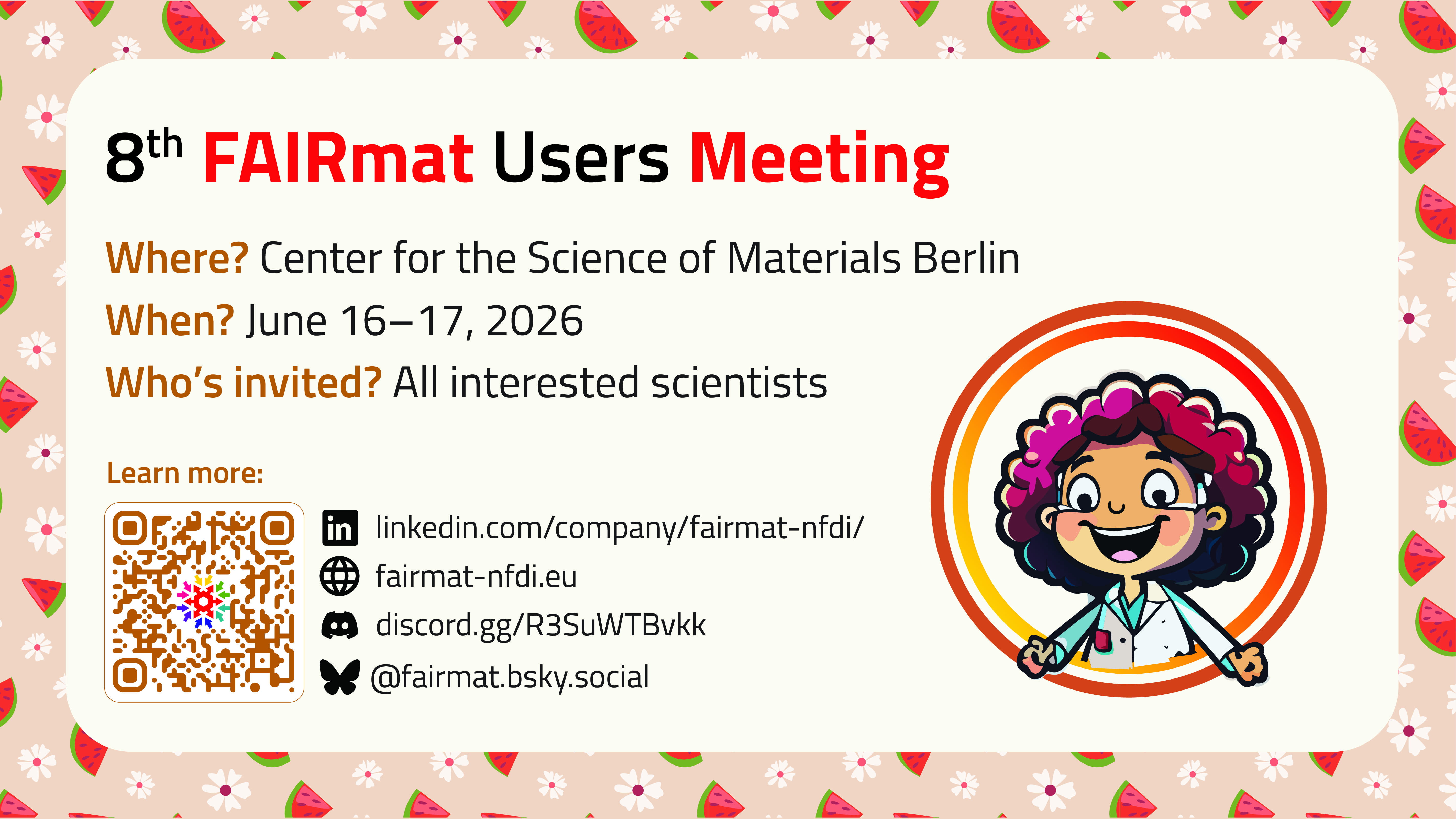
Eighth FAIRmat Users Meeting

Europe/Berlin
2.049 (Center for the Science of Materials Berlin (CSMB))

2.049

Center for the Science of Materials Berlin (CSMB)

Zum Großen Windkanal 2 12489 Berlin
Description

We are pleased to announce the eighth FAIRmat Users Meeting, which will take place in Berlin from June 16 to 17, 2026.

The FAIRmat Users Meeting is a central event for scientists and data stewards in physics, chemistry, and materials science interested in practical research data management (RDM) and its role in accelerating scientific discovery. Through hands-on tutorials and real-world use cases, the meeting demonstrates how FAIR data practices using NOMAD can support experimental and computational research workflows.

The program will begin with an overview of recent FAIRmat developments and new NOMAD features, followed by hands-on sessions focused on practical RDM implementation. Tutorials will guide participants through the basics of getting started with NOMAD, including data structuring and role-based usage. Topics will range from basic GUI functions to plugin development and NOMAD Oasis administration.

The first day will conclude with the Users-Meet-Developers exhibit. This open forum offers participants the opportunity to present their work, exchange ideas, and interact directly with NOMAD developers and FAIRmat experts. The session will be accompanied by food and refreshments, creating a relaxed setting for informal discussions and networking. Participants interested in presenting and discussing their RDM workflows, uploaded datasets, developed plugins, custom schemas, data analysis tools, or other related solutions are invited to indicate this in the registration form.

On June 17, NOMAD users will share their experiences and best practices for managing, sharing, and analyzing research data using the NOMAD ecosystem.

Whether you are an experienced NOMAD user or are just beginning your RDM journey, this meeting will provide you with practical skills, new insights, and valuable networking opportunities.

We look forward to stimulating discussions, hands-on sessions, and community building!
    • 12:00 PM 1:30 PM
      Registration & Lunch 1h 30m 2.049

      2.049

      Center for the Science of Materials Berlin (CSMB)

      Zum Großen Windkanal 2 12489 Berlin
    • 1:30 PM 2:00 PM
      FAIRmat and NOMAD: Recent Developments and Future Directions 2.049

      2.049

      Center for the Science of Materials Berlin (CSMB)

      Zum Großen Windkanal 2 12489 Berlin

      In this overview talk, I will present recent developments across FAIRmat and the NOMAD ecosystem, highlighting the continued growth of the platform as a research data infrastructure for materials science. FAIRmat now supports a broad range of research activities, from individual projects and laboratory workflows to institutional data management and collaborative research environments.

      The presentation will showcase recent advances across the ecosystem, including improvements to data management, metadata handling, workflow support, data exploration, and deployment options. Through selected examples, I will demonstrate how these developments help researchers and organizations manage research data more effectively while enabling FAIR and reproducible research practices.

      The talk will conclude with an outlook on the next phase for FAIRmat and NOMAD, highlighting emerging capabilities, expanding application areas, and the growing role of FAIR research data in data-driven and AI-based scientific discovery.

      Convener: Lukas Pielsticker (FAIRmat / HU Berlin)
    • 2:00 PM 6:30 PM
      Hands-on Tutorials
      • 2:00 PM
        Deploying NOMAD Oasis with Kubernetes 2h 1.021 (Center for the Science of Materials Berlin (CSMB))

        1.021

        Center for the Science of Materials Berlin (CSMB)

        Zum Großen Windkanal 2 12489 Berlin

        Many existing NOMAD Oasis installations rely on Docker Compose, which has long been the recommended and most widely used deployment approach. While this setup works well for smaller environments, it can become limiting when scaling to larger workloads or more complex infrastructures.

        In this workshop, I will introduce an alternative deployment strategy using Kubernetes. This approach enables more flexible scaling of computational workloads across multiple nodes, while also providing robust tools for service lifecycle management, monitoring, and resilience.

        The session will include a live demonstration based on a local development setup that participants can replicate on their own laptops. Building on this, we will explore how the same deployment can be extended to a cloud environment, running across multiple virtual machines to achieve a scalable and production-ready system.

        By the end of the workshop, attendees will have a practical understanding of how Kubernetes can be used to deploy and manage NOMAD Oasis in both local and cloud-based scenarios.

        Speaker: Lauri Himanen
      • 2:00 PM
        Getting Started with NOMAD for Materials-Science Research Data Management 2h 2.049 (Center for the Science of Materials Berlin (CSMB))

        2.049

        Center for the Science of Materials Berlin (CSMB)

        Zum Großen Windkanal 2 12489 Berlin

        In this hands-on workshop, you will learn how to efficiently search, filter, and explore data in NOMAD. We will guide you through managing, uploading, and sharing your research data, as well as steps to publish datasets with DOIs to guarantee accessibility and reusability. You will also gain practical experience using NOMAD’s ELN functionality to document your research. Please bring your laptop to participate in the interactive exercises.

        Speaker: Siamak Nakhaie (Humboldt-Universität zu Berlin)
      • 4:00 PM
        Coffee Break 30m
      • 4:30 PM
        Expert Panel: Deploying RDM Infrastructure across Research Organizations Using NOMAD Oasis (hybrid) 2h 2.049 (Center for the Science of Materials Berlin (CSMB))

        2.049

        Center for the Science of Materials Berlin (CSMB)

        Zum Großen Windkanal 2 12489 Berlin

        This session is aimed at decision-makers who are evaluating, planning, or operating Research Data Management (RDM) infrastructure. Using NOMAD Oasis as a concrete example, the discussion will focus on the strategic, organizational, and practical realities of deploying RDM platforms. It will also provide those new to NOMAD Oasis with a grounded introduction to how such systems are being adopted and operated across real institutional settings.

        The panel brings together speakers with experience of RDM adoption across a range of institutional contexts, from individual research groups to cross-institutional networks and industry collaborations. Together, they will offer perspectives on how organizations approach RDM adoption under different scientific, organizational, and resource constraints.

        The discussion will focus on questions that matter most in practice: how deployments are scoped and governed, what investments are required, how sustainability is maintained over time, and how institutions balance centralized coordination with distributed access and autonomy. Technical details will be addressed only where they directly inform strategic or organizational decisions.

        The session will combine short flash talks, a moderated panel discussion, and open audience Q&A to encourage exchange between organizations at different stages of their RDM journey.

        Speaker: Joseph Rudzinski (Humboldt University)
      • 4:30 PM
        Parsing in NOMAD: from Raw Files to Structured Entries 2h 1.021 (Center for the Science of Materials Berlin (CSMB))

        1.021

        Center for the Science of Materials Berlin (CSMB)

        Zum Großen Windkanal 2 12489 Berlin

        Parsing in NOMAD is a central component of automated data ingestion, enabling the conversion of raw files into structured entries. This tutorial presents several parsing scenarios that differ in their level of automation and editability of resulting entries, and outlines recommended practices for parser design. The hands-on session will guide participants through the main stages of parser development, from schema creation to parser testing.

        Participants are requested to bring a laptop with an IDE, such as Visual Studio Code, as well as Git, Python, and a GitHub account.

        Speakers: Lev Ginzburg (HU Berlin), Sarthak Kapoor (FAIRmat | HU Berlin)
    • 6:30 PM 8:30 PM
      Users-Meet-Developers Exhibit & Dinner Foyer

      Foyer

      Center for the Science of Materials Berlin (CSMB)

      Zum Großen Windkanal 2 12489 Berlin

      This open forum will offer participants the opportunity to showcase their work, exchange ideas, and interact directly with NOMAD developers and FAIRmat experts. Users will present and discuss their RDM workflows with NOMAD, uploaded datasets, developed plugins, custom schemas, data analysis tools, or other related solutions.

  • Wednesday, June 17
    • 9:00 AM 12:00 PM
      Invited Talks: NOMAD Applications and Use Cases (hybrid) 2.049

      2.049

      Center for the Science of Materials Berlin (CSMB)

      Zum Großen Windkanal 2 12489 Berlin
      • 9:00 AM
        Data @Big Chemistry: Deploying NOMAD Oasis as a User Platform 25m

        Big Chemistry is a national growth fund project from the Netherlands (https://bigchemistry.nl/). Big Chemistry aims to establish an autonomous “RobotLab” that combines chemical robotics, artificial intelligence and intensive data collection. We aim to bring a Big Data Driven approach to Chemistry with a focus on applications in formulation science. We thus require a robust data management infrastructure. The consortium includes 5 academic institutions located across the Netherlands and a growing number of industrial partners. NOMAD Oasis was selected as part of our data management solution to enable the sharing of operationally FAIR data which is discoverable and browsable for scientists across the consortium. We present the process of deploying multiple NOMAD Oasis instances as a data platform, and the additional requirements that industrial collaborations place on data management, including additional cyber security considerations.

        Speaker: Mark Driver
      • 9:25 AM
        NOMAD Oasis for Electron Microscopy 25m

        Electron microscopes come in many flavours, with instruments ranging from table-top scanning electron microscopes to 4 or more meters tall (scanning) transmission electron microscopes with hundreds of electron optical elements in them. Likewise, the type of data they produce is very diverse, ranging from spectra to diffraction patterns and images, and 3D, 4D, 5D, or higher dimensional hypercubes of data, which are stored in different proprietary formats, depending on the instrument vendor. In this presentation I will introduce the NOMAD-Oasis setup we run within the structure research and electron microscopy group at the physics department of HU Berlin. I will highlight the pynxtools-em software which allows us to convert data from different vendors to an open data standard, which NOMAD is able to display, independent of the dimensionality of the data. I will also show how the NOMAD Remote Tools Hub (NORTH) is utilized to perform complex data processing tasks of data sets being several tens of GB in size, and incorporating high-performance computing, directly on the server – including tools which can be controlled using natural language.

        Speaker: Christoph T. Koch
      • 9:50 AM
        Scaling NOMAD Adoption Across Research Communities 25m

        FAIRmat and NOMAD provide a powerful foundation for FAIR and AI-ready research data management. However, translating these capabilities into real research workflows often requires additional integration, infrastructure, onboarding, and workflow adaptation efforts. In this talk, we present practical experiences from Glaide Data GmbH supporting NOMAD adoption across research groups, consortia, and emerging communities beyond FAIRmat’s core domains. We discuss strategies for integrating NOMAD into existing research environments, evaluating and adapting community plugins and schemas, and accelerating adoption through practical implementation, infrastructure support, training, and onboarding. Through concrete examples, we highlight how these efforts can help extend the impact and reach of the FAIRmat ecosystem.

        Speaker: Joseph Rudzinski (Humboldt University)
      • 10:15 AM
        Coffee Break 30m
      • 10:45 AM
        Customizing NOMAD Oasis for Thin-film Research in Sustainable Energy Materials 25m

        Research at the Sadewasser Research Group focuses on sustainable energy materials for applications in photovoltaics and batteries. These research activities involve a broad range of deposition techniques, wet and dry laboratory processes, and advanced characterization methods, generating heterogeneous datasets that must be organized in a consistent and traceable manner.
        This presentation describes the development of a custom NOMAD Oasis plugin created to support the organization of experimental activities within our group. The plugin was designed to reflect the structure of our laboratory practices and to facilitate the integration of data and metadata associated with thin-film fabrication, processing, and advanced characterization across different research lines and applications.
        The talk will discuss the practical process of translating laboratory procedures and experimental relationships into NOMAD schemas and plugin components, including approaches for metadata organization, representation of experimental processes, and adaptation of the Oasis environment to the day-to-day needs of experimental research.
        In addition, the presentation will explore the use of AI-assisted programming tools during the implementation of the plugin. By integrating large language model–based coding assistants into the development process, it became possible to quickly extend custom NOMAD functionality with a relatively small development effort. A short live demonstration will illustrate how AI-assisted development can support the customization of NOMAD Oasis environments for specific experimental contexts.

        Speaker: Diego Alejandro Garzon
      • 11:10 AM
        Automating Research Workflows with NOMAD Actions 25m

        NOMAD Actions provide a framework for executing complex or resource-intensive workflows within NOMAD. They are ideal for tasks that require special resources like GPUs, have long execution times, or need to interact with external systems, offering a more powerful alternative to standard normalizers.

        Built as plugin entry points, Actions use Temporal.io to orchestrate workflows made up of reliable, self-contained steps. Temporal handles the hard distributed computing problems, such as fault tolerance, retries, and scaling, so that the plugin authors can focus on the core scientific logic. The resulting workflows can be triggered and inspected from the NOMAD GUI.

        We illustrate Actions with examples from automated data processing and advanced ML workflows. These example Actions are already deployed in lab environments, supporting ML-assisted characterization, generative AI model sampling, and large-scale data transformation.

        Speakers: Ahmed Ilyas, Lev Ginzburg (HU Berlin), Sarthak Kapoor (FAIRmat | HU Berlin)
      • 11:35 AM
        AI-Assisted Scientific Data Extraction 25m

        Scientific progress increasingly depends on the ability to transform unstructured information into accessible, structured data. However, the rapid growth of scientific literature has made manual data extraction and curation a major bottleneck across disciplines. Recent advances in artificial intelligence offer new opportunities to automate this process and unlock knowledge at unprecedented scale.

        This session will explore emerging AI-assisted approaches for scientific data extraction, focusing on multimodal workflows that convert diverse information sources into structured, machine-readable datasets. We will present recent developments in NOMAD that leverage large language models and domain-specific validation to extract scientific information from research publications, enabling the creation of continuously updated knowledge resources. In addition, we will showcase new capabilities that extend data extraction beyond traditional documents, including the use of speech and audio inputs as alternative pathways for capturing and structuring scientific knowledge.

        Through examples from materials science and photovoltaics, we will discuss the opportunities, challenges, and limitations of AI-driven extraction systems, including issues of accuracy, validation, reproducibility, and integration with existing scientific infrastructures. The session aims to provide researchers with an overview of how AI can accelerate the transformation of scientific content into reusable data and support data-driven discovery in an era of rapidly expanding scientific output.

        Speakers: Sherjeel Shabih, yaru wang
    • 12:00 PM 1:00 PM
      Lunch 1h 2.049

      2.049

      Center for the Science of Materials Berlin (CSMB)

      Zum Großen Windkanal 2 12489 Berlin